Many business owners in Lagos and across Nigeria spend hundreds of thousands of naira building a beautiful website, only to watch it sit quietly, generating almost no traffic, no leads, and no sales. If that sounds familiar, you’re not alone, and you’re not doing anything “wrong.” You’re just missing one piece of the puzzle: blogging.
A website without a blog is like a shop with a locked door. People can see the signboard from the road, but nobody can walk in. In this article, we’ll answer the question “what is blogging” in plain terms, and show you exactly why it matters for your business, whether you run a school, a church, an NGO, a startup, or an SME. By the end, you’ll understand how a simple, consistent blogging habit can turn your website into your hardest-working salesperson.
What Is Blogging?
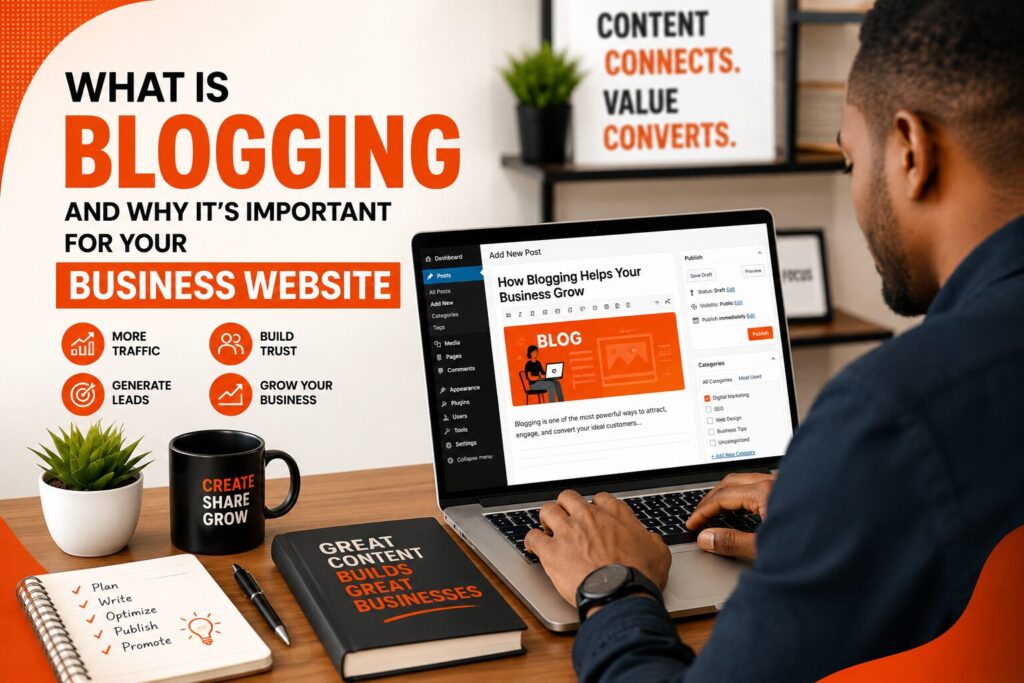
Blogging is the practice of regularly publishing articles, guides, updates, or stories on a website to inform, educate, or engage a specific audience. Each article is called a “blog post,” and the collection of posts, usually listed in reverse chronological order, is called a “blog.”
Blogging began in the late 1990s as a kind of online diary; people wrote about their personal lives, hobbies, and opinions. Today, it has evolved into one of the most powerful tools in digital marketing. Businesses of every size now use blogging to answer customer questions, build trust, and attract free traffic from Google.
Blog vs. Website: What’s the Difference?
A website is your business’s digital home; it includes your homepage, About page, Services page, and Contact page. These pages are usually static; they don’t change often. A blog, on the other hand, is a dynamic section of that same website where new content is added regularly.
Think of your website as a building and your blog as the noticeboard inside it, constantly updated with fresh, useful information that gives people a reason to keep coming back.
Blog Posts vs. Website Pages
| Feature | Website Page | Blog Post |
|---|---|---|
| Purpose | Describes your business, services, or products | Educates, informs, or answers a question |
| Update frequency | Rarely changes | Published regularly |
| Example | “About Us,” “Our Services” | “5 Signs Your Business Website Needs a Redesign” |
| SEO role | Targets core service keywords | Targets long-tail, informational keywords |
For example, a school in Ayobo might have a website page titled “Admissions,” which stays the same for years. But a blog post titled “How to Choose the Right Nursery School in Ayobo, Lagos” can be published, shared, and updated to keep attracting new parents searching on Google.
Why Blogging Is Important for Your Business Website
If you’re still wondering whether blogging is worth your time, here are ten concrete reasons Nigerian businesses from startups to established SMEs are investing in it.
1. Helps Your Website Rank on Google
Every blog post is a new page that Google can index and rank. Without a blog, your website may only have five or six pages competing for search visibility. With a blog, you can have fifty, a hundred, or more, each one targeting different keywords your potential customers are typing into Google.
2. Increases Organic Traffic
More indexed pages targeting relevant keywords means more opportunities to appear in search results. A well-optimized blog post on “affordable website design in Lagos” can bring in visitors for months or years after publication, without you spending a kobo on ads.
3. Builds Trust and Credibility
When a visitor lands on your site through a helpful article and finds genuinely useful information, they start to trust your brand before they’ve even spoken to you. Trust is the foundation of every sale, especially in Nigeria’s competitive service market.
4. Positions You as an Industry Expert
Consistently publishing well-researched content signals that you know your field. A church’s blog explaining “How to Start a Media Ministry” or a company’s post on “Common WordPress Security Mistakes” both do the same job: they position the author as someone worth listening to.
5. Generates Qualified Leads
Blog posts can include calls-to-action (CTAs) that guide readers toward a next step, booking a consultation, downloading a resource, or contacting your team. Unlike cold traffic, people who arrive via a blog post are already interested in the topic, making them warmer, more qualified leads.
6. Answers Customers’ Questions Before They Ask
Every business gets the same questions repeatedly. A blog lets you answer them once, in detail, and share the link forever. This saves your team time and gives prospective customers confidence that you understand their needs.
7. Supports Social Media Marketing
Blog posts give you something valuable to share on Facebook, Instagram, LinkedIn, and WhatsApp Status — instead of only posting promotional flyers. This keeps your social media content varied, useful, and less “salesy.”
8. Improves Local SEO
For businesses serving specific areas such as Ikeja, Alimosho, Ipaja-Ayobo, or Egbeda, blog posts that mention local landmarks, neighborhoods, and community needs help you rank for “near me” and location-based searches, which are increasingly common in Nigeria as more people search on mobile.
9. Keeps Your Website Fresh
Search engines favor websites that are regularly updated. A blog gives you a natural, sustainable reason to update your site frequently without redesigning it every few months.
10. Helps Convert Visitors Into Customers
Ultimately, blogging isn’t just about traffic; it’s about turning strangers into leads and leads into paying customers. A helpful article, paired with a clear CTA, moves people gently down the sales funnel.
How Blogging Improves SEO
To understand why blogging works so well for search engine optimization, it helps to look at the mechanics behind it.
Keywords and Search Intent
Every blog post should be built around a keyword or phrase that real people are searching for, and it should match their search intent, whether they want information, comparisons, or to make a purchase. Google rewards content that satisfies what the searcher actually wants.
Internal Linking
Blog posts allow you to link naturally to your core service pages — for example, linking the phrase “professional website design” to your Website Design Services page. This helps both users and search engines navigate your site and understand which pages matter most.
Backlinks
Genuinely useful blog content is more likely to be referenced or linked to by other websites, directories, and partners, which strengthens your site’s authority over time.
Fresh Content and User Engagement
Google’s algorithms notice when a site is actively maintained and when visitors spend time reading, clicking, and returning. Blogging feeds both signals.
Topical Authority and E-E-A-T
Google evaluates content based on Experience, Expertise, Authoritativeness, and Trustworthiness (E-E-A-T) — a framework described in Google Search Central’s own guidance for creators. Publishing a body of well-researched, accurate posts around your niche builds exactly this kind of topical authority over time.
Types of Blog Posts Every Business Should Publish
You don’t need to reinvent the wheel with every post. Most successful business blogs rotate through a handful of proven formats:
- How-to guides – e.g., “How to Set Up a Corporate Email for Your Business”
- Tutorials – step-by-step walkthroughs of a process or tool
- Frequently Asked Questions – answering common customer queries in depth
- Industry news – commentary on relevant trends or updates
- Case studies – real (or anonymized) examples of results you’ve delivered
- Success stories – client wins and testimonials told as narratives
- Product or service updates – new offerings or improvements
- Comparison articles – e.g., “WordPress vs. Wix: Which Is Better for Nigerian Businesses?”
- Checklists – practical, scannable action lists
- Beginner guides – foundational content for newcomers to a topic
Blogging Mistakes to Avoid
Even well-meaning businesses sabotage their blogging efforts with a few common mistakes:
- Publishing without keyword research — writing about what you assume people search for, instead of validating it
- Thin content — short, shallow posts that don’t fully answer the question
- Duplicate content — copying text from other sites, which can hurt rankings
- Ignoring mobile users — most Nigerian readers browse on phones, so unoptimized formatting drives them away
- No internal links — missing the chance to guide readers toward your services
- No clear call-to-action — leaving readers unsure of what to do next
- Irregular publishing — starting strong, then abandoning the blog for months
- Writing only promotional content — turning every post into an advert, which readers quickly learn to ignore
How Often Should You Publish Blog Posts?
There’s no single “magic number,” but consistency matters far more than volume. A business that publishes one high-quality, well-researched post every week will outperform one that publishes five rushed posts and then goes silent for three months.
For most small businesses and SMEs, a realistic and sustainable starting point is one to two blog posts per week. If that’s not feasible, even two well-optimized posts per month, published consistently, can produce meaningful results over six to twelve months. The key is picking a rhythm you can actually maintain.
Why WordPress Is the Best Platform for Blogging
WordPress powers a huge share of websites globally, and for good reason — especially for Nigerian businesses that want control without needing to code.
- Easy editing — the block editor makes writing and formatting simple, even for non-technical users
- SEO plugins — tools like Yoast SEO and Rank Math guide you through on-page optimization as you write
- Fast performance — with the right hosting and caching setup, WordPress sites can load quickly even on average Nigerian internet speeds
- Scalability — from a single blog to a full eCommerce store, WordPress grows with your business
- Categories and tags — built-in tools to organize content logically for both readers and search engines
- Media management — a straightforward media library for images, videos, and downloadable resources
WordPress’s own documentation and support resources make it accessible even for beginners who have never managed a website before.
How Techlevels Web Solution Can Help


Knowing that blogging matters is one thing; actually setting it up, optimizing it, and keeping it running consistently is another. This is where Techlevels Web Solution comes in.
Based in Lagos, Techlevels Web Solution helps small businesses, entrepreneurs, startups, NGOs, schools, and churches across Nigeria build websites that don’t just look good but actually work for the business. Our services include:
- Professional Website Design
- WordPress Development
- Blog Setup and Configuration
- SEO Optimization
- Content Strategy
- Website Maintenance
- Local SEO for businesses in areas like Ikeja, Alimosho, Ipaja, and Egbeda
- Website Speed Optimization
Whether you’re starting from scratch or already have a website that simply isn’t generating traffic, our team can set up a fully optimized blog structure, help you plan content that matches what your customers are actually searching for, and keep your site technically healthy so your content has the best chance of ranking.
Conclusion
Blogging is no longer optional for businesses that want to be found online; it’s one of the most cost-effective ways to build trust, rank on Google, and turn website visitors into paying customers. From improving your SEO and local visibility to answering customer questions and supporting your social media, a well-maintained blog works for your business around the clock.
The businesses winning online in 2026 aren’t necessarily the ones with the biggest budgets; they’re the ones publishing consistent, genuinely useful content that their customers are searching for.
If your website has been sitting quietly without a blog, now is the time to change that. Contact Techlevels Web Solution today for a professional, SEO-ready website and a content strategy built around your business goals.
Frequently Asked Questions
What is blogging? Blogging is the practice of regularly publishing articles on a website to inform, educate, or engage a target audience, to attract and retain visitors over time.
Is blogging still relevant in 2026? Yes. Blogging remains one of the most effective long-term strategies for organic traffic, brand trust, and lead generation, even as new content formats like video and social media continue to grow.
Does blogging help SEO? Yes. Blogging creates more indexed pages, targets more keywords, supports internal linking, and signals to search engines that a website is active and valuable, all of which contribute to better rankings.
How often should businesses blog? Consistency matters more than frequency. One to two well-optimized posts per week is ideal, but even two posts per month, published regularly, can produce meaningful long-term results.
Can blogging generate customers? Yes. Blog posts that answer real customer questions and include clear calls-to-action can move readers from casual visitors to qualified leads and, eventually, paying customers.
What should businesses write about? Businesses should write about the questions, problems, and topics their customers are already searching for. How-to guides, FAQs, comparisons, checklists, and success stories are all effective formats.
Is WordPress good for blogging? Yes. WordPress offers an easy editor, powerful SEO plugins, fast performance with proper hosting, and flexible organization tools like categories and tags, making it one of the best platforms for business blogging.
How long should a blog post be? There’s no fixed rule, but most well-performing business blog posts fall between 1,000 and 2,500 words, long enough to fully answer the topic without unnecessary padding.
What is the difference between a blog and a website? A website is the overall digital home for a business, including static pages like “About” and “Services.” A blog is a regularly updated section of that website used to publish articles and engage readers.
Can Techlevels help me start a business blog? Yes. Techlevels Web Solution offers website design, WordPress development, blog setup, SEO optimization, and content strategy services to help Nigerian businesses build blogs that actually drive results.