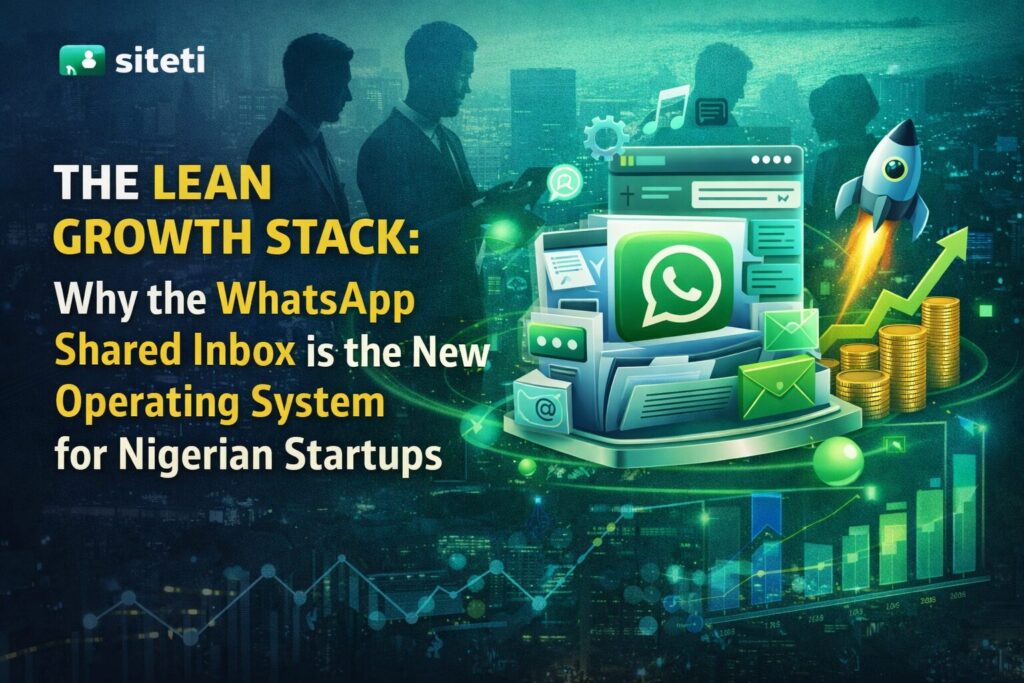
Nigerian startups are increasingly adopting a WhatsApp shared inbox for Nigerian startups as part of their lean growth stack. Instead of managing customer conversations across multiple phones and scattered chats, startups are turning WhatsApp into a centralized workspace for sales, customer support, and team collaboration.
In the Nigerian business ecosystem of 2026, the traditional “Customer Service Department” has undergone a forced evolution. The era of the fragmented business, where marketing lived in one app, sales in another, and support on a single physical phone, has ended. Founders have realized that in a high-velocity market like Lagos, Abuja, or Port Harcourt, the “response gap” is where revenue goes to die. The solution hasn’t been to hire more people, but to deploy a more intelligent, scalable architecture: The WhatsApp-First Growth Stack.
At the center of this stack isn’t a static website or a complicated storefront, but a WhatsApp shared inbox solution that serves as the central nervous system for the entire enterprise. By virtualizing the “front desk,” Nigerian tech and service brands are finally solving the dual challenges of massive scale and localized trust. This is no longer just about “chatting” with customers; it is about building a programmable, automated interface for the modern African consumer.
1. The Collapse of “SIM-Card Solitude.”
For years, Nigerian SMEs operated in what can be called “SIM-Card Solitude.” The entire business relationship with thousands of customers lived on one physical device, often held by a single employee. This was a “Single Point of Failure” model that made scaling impossible. If that device were lost, the business would be blinded. If the staff member holding that device was stuck in traffic or on leave, the customer queue grew indefinitely.
The transition to a Shared WhatsApp Inbox via an official API provider has effectively “de-privatized” the customer conversation. It moves the chat from a physical object into a secure, cloud-hosted environment where multiple agents, be they in a home office in Lekki, a co-working space in Kaduna, or a remote hub in London, can collaborate on a single thread in real-time.
Granular Accountability and Team Collaboration
Unlike the standard WhatsApp Business App, which limits linked devices and offers zero oversight, the Shared Inbox provides a “Manager’s Eye View.”
- Audit Trails: Every message is timestamped and linked to a specific agent. If a customer complains about a bad experience, you can trace exactly what was said and by whom.
- Internal Chat-within-Chat: Agents can leave internal notes for each other on a customer’s profile that the customer never sees. For instance, a sales rep can leave a note saying, “Customer is looking for a discount, check previous transaction history before responding.”
- Dynamic Assignment: New inquiries can be automatically routed based on “First-Come, First-Served” or assigned to specific departments like “Billing” or “Technical Support.”
2. Engineering “Contextual Empathy” through Marketing Automation
In 2026, the Nigerian consumer is savvier than ever. They have developed a “spam filter” for generic broadcasts. If they receive a message that feels like a mass blast, their response is an immediate block. The growth hack of this decade isn’t volume; it’s Contextual Empathy. This is achieved by layering Marketing Automation directly onto the Shared Inbox data.
Instead of a 10,000-person “spray and pray” blast, the automated engine uses CRM data to trigger “Event-Based” messages that feel personal and timely.
The Abandoned Intent Trigger
Consider a user who interacts with your WhatsApp bot to check a price list but exits before making a purchase. In the old model, that lead is lost. In the Growth Stack model, the system detects this “Abandoned Intent” and automatically sends a polite, non-intrusive follow-up message four hours later: “Hi [Name], I noticed you were looking at our premium plans. Do you have any questions about the setup process?” This single automated touchpoint can increase conversion rates by up to 30% without any manual effort from your sales team.
The Loyalty and Re-engagement Loop
Automated messages can also be programmed to maintain the “Loyalty Loop.” For example, if a customer hasn’t purchased in 45 days, the system can trigger a personalized “We Miss You” offer. Because this is sent via the official API, it lands in the main chat list with a high open rate, rather than being buried in an “Updates” or “Spam” folder in an email inbox.
3. The Middleware Revolution: Webhooks and API Synergies
Nigerian tech startups are increasingly using the WhatsApp API as a “Middleware” layer, the bridge between their core web application and the user’s mobile device. This is where the power of Webhooks becomes undeniable. A webhook is essentially a “digital nudge” that tells one system that something has happened in another.
Instant Verification and Transaction Security
Fintechs in Nigeria are rapidly moving away from the unreliable world of SMS OTPs. With the rising cost and falling delivery rates of traditional SMS, WhatsApp has become the preferred channel for:
- One-Time Passwords (OTPs): Near-100% delivery rates ensured by Meta’s global infrastructure.
- Transaction Alerts: Instant notifications for every credit and debit, providing users with peace of mind in a high-fraud environment.
- KYC Document Submission: Users can take a photo of their ID and upload it directly through a WhatsApp chat, where a webhook pushes it to the company’s backend for verification.
4. Financial Sovereignty: The Naira-Billing Mandate
One cannot discuss the Nigerian tech stack without addressing the “Dollar Crisis” of 2024-2025. For far too long, Nigerian businesses were at the mercy of international billing cycles in USD. A $100 monthly subscription for a CRM or API tool was a moving target that could devitalize a small team’s budget within weeks due to FX volatility.
The move toward Naira-billed WhatsApp API providers in Nigeria is more than a convenience; it is a declaration of financial independence. It allows founders to build their “Lean Growth Stack” on a foundation of predictable, fixed costs. When you pay for your Shared Inbox and Automation engine in the same currency your customers use to pay you, you eliminate a layer of risk that has historically stunted the growth of indigenous firms. This stability allows for long-term hiring and aggressive marketing spend that wouldn’t be possible under a USD-denominated overhead.
5. The “Invisible” Call Center: Support without the Overhead
The most significant impact of this stack is the total virtualization of the support center. The “Call Center” is no longer a high-rent room in an office park in VI; it is a distributed network of human talent and machine logic.
Infrastructure Savings
By removing the need for physical PBX systems, proprietary headsets, and dedicated office desks, businesses are saving up to 70% on operational overhead. This saved capital is then redirected into customer acquisition or product development.
Talent Access and Resilience
The “Invisible Call Center” allows you to hire the best support agents regardless of where they live. You can tap into the brilliant talent pools in Nsukka, Ilorin, or Calabar. This also creates a more resilient business. If there is an internet blackout or a security curfew in Lagos, your agents in Abuja and Port Harcourt continue to handle the Shared Inbox without a second of downtime.
6. Mastering the New Operating System
The WhatsApp Shared Inbox is the new “Operating System” for the Nigerian enterprise. It is the place where marketing meets sales, where the lead meets the support, and where the brand meets the human.
By integrating official API access, intelligent automation, and local billing, Nigerian businesses are doing more than just “chatting.” They are building a high-conversion, low-friction engine that is finally capable of meeting the Nigerian consumer exactly where they live. The “Dot Com” was a destination that users had to find; the “WhatsApp Stack” is a relationship that lives in their pocket. And in 2026, the brands that win are the ones that are always one message away.